
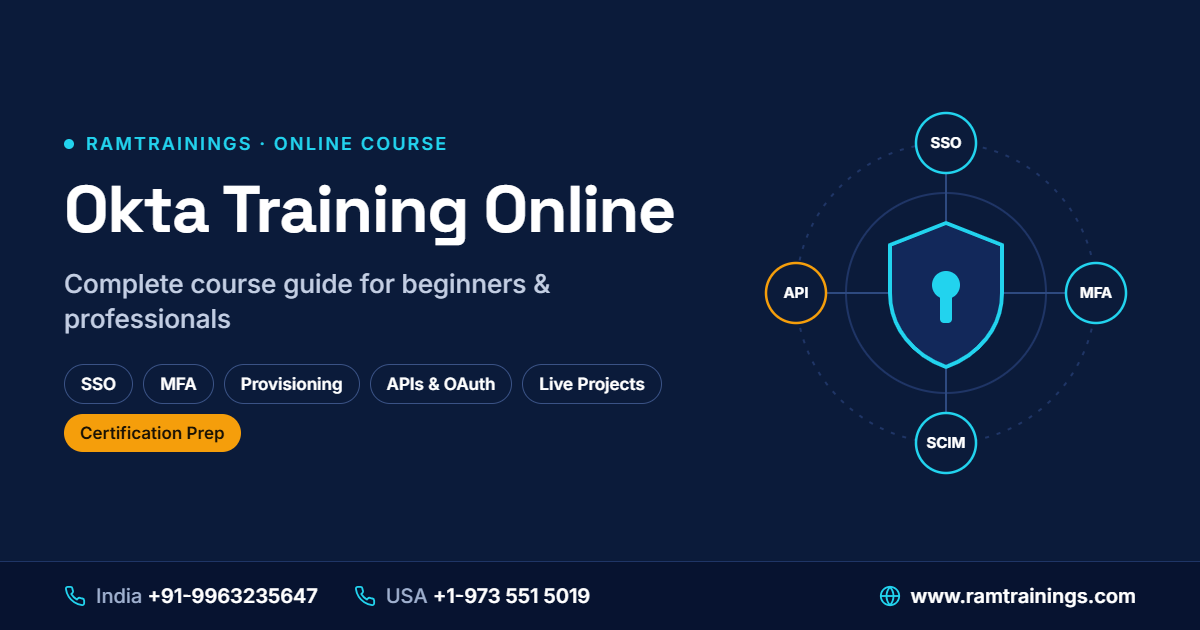
Okta training online helps beginners and IT professionals learn how to manage digital identities, configure Single Sign-On (SSO), implement Multi-Factor Authentication (MFA), automate user provisioning, and integrate enterprise applications. A structured Okta training course combines identity and access management (IAM) concepts with practical configuration, troubleshooting, and project-based learning. It can help learners build skills relevant to Okta Administrator, IAM Engineer, and Okta Developer roles.
What Is Okta and Why Is It Important?
Okta is an identity and access management platform that helps organizations manage user identities and control access to applications. Businesses use identity management solutions to protect accounts, simplify authentication, and manage employee access across cloud and enterprise systems.
For example, when an employee joins a company, an administrator may need to create an account, assign application access, enforce authentication policies, and configure secure login. When the employee changes roles or leaves, their access may need to be updated or revoked.
Okta supports identity-related processes such as:
- Single Sign-On (SSO): Allows users to access multiple supported applications through a centralized authentication experience.
- Multi-Factor Authentication (MFA): Adds verification steps to strengthen account security.
- User provisioning: Helps create and manage user accounts and application access.
- Directory integration: Connects identity information across supported directory services.
- Application integration: Enables applications to use supported authentication and authorization methods.
Learning these concepts gives IT professionals a foundation for understanding how identity security works in modern organizations.
Why Choose Okta Training Online?
Online training provides a flexible way to learn identity management without requiring regular travel to a physical classroom. It can be suitable for working professionals, recent graduates, system administrators, developers, and IT support engineers.
A well-structured Okta course should explain concepts, demonstrate configurations, and give learners opportunities to apply what they learn.
Key benefits include:
- Flexible learning: Choose a suitable live or self-paced format, depending on availability.
- Practical knowledge: Understand how identity management tasks are performed in real environments.
- Technical skill development: Learn SSO, MFA, application integration, APIs, and user lifecycle management.
- Certification preparation: Build knowledge relevant to the certification pathway you plan to pursue.
- Career preparation: Develop technical understanding that can support interviews and IAM-related responsibilities.
However, completing a training course does not automatically provide an Okta certification or guarantee employment. Certification requires meeting the applicable requirements and passing the relevant examination.
What Does an Okta Training Course Cover?
Before enrolling, review the syllabus to ensure it covers both administrative and development concepts relevant to your goals.
1. Okta Fundamentals and User Management
Beginners should start by understanding the Okta administrative environment, users, groups, profiles, and administrator roles.
Important topics include creating and managing users, importing user information, assigning groups, understanding profile attributes, and configuring appropriate administrative permissions. These concepts establish the foundation for more advanced identity management tasks.
2. Single Sign-On and Application Integration
SSO is an important part of enterprise identity management. Training should explain how applications connect to an identity provider and how authentication information is exchanged.
Relevant topics include:
- SAML-based application integration
- OpenID Connect (OIDC) fundamentals
- Application onboarding and configuration
- User and group assignments
- Authentication troubleshooting
Understanding these concepts helps learners recognize common integration problems and investigate their causes.
3. Multi-Factor Authentication and Security Policies
Organizations use authentication policies to control how users access applications and resources. An Okta course should introduce MFA configuration, sign-on policies, password policies, and relevant security settings.
Learners should understand how authentication requirements affect the user experience and why policies must be configured according to an organization's security needs.
4. Directory Integration and User Provisioning
Directory integration connects user information across supported systems. Provisioning manages account creation, updates, and access changes.
A course may cover Active Directory integration, directory synchronization, group management, application provisioning, and SCIM concepts. These skills are useful for understanding employee onboarding, role changes, and offboarding processes.
5. Okta APIs and Developer Concepts
Professionals interested in technical integration should learn how Okta APIs support identity-related operations.
Relevant subjects include REST APIs, API tokens, OAuth 2.0, authorization servers, scopes, claims, and application authentication flows. Developer-focused training can also cover how applications integrate with identity services and how automated workflows reduce repetitive administrative tasks.
What Practical Projects Should You Learn in Okta Training?
Practical projects help learners connect theoretical concepts with implementation tasks. When evaluating a course, look for exercises that reflect common enterprise identity scenarios.
- Single Sign-On (SSO) rollout: Connect applications (Salesforce, Slack, Workday, AWS, Office 365, etc.) to Okta using SAML, OIDC, or WS-Federation, so users log in once and reach everything.
- Multi-Factor Authentication (MFA): Roll out Okta Verify, FIDO2/WebAuthn security keys, SMS, or biometrics, including designing authentication policies.
- Lifecycle management and provisioning: Automate joiner-mover-leaver processes using SCIM or API integrations.
- HR-driven identity (HRIS integration): Use Workday, BambooHR, or SuccessFactors as the source of truth pushing identities to Active Directory and SaaS apps.
- Directory integration and migration: Integrate Active Directory or LDAP using Okta agents, sync users, or migrate off on-prem AD toward a cloud-first setup.
- Adaptive and contextual access policies: Build rules based on device, network zone, location, and risk.
- Device trust: Combine Okta with MDM/EDR tools (Intune, Jamf, CrowdStrike) so only managed devices reach corporate apps.
- Passwordless authentication: Move toward Okta FastPass, passkeys, or security keys to reduce reliance on passwords.
- Customer Identity (Okta CIAM / Auth0): Add login, registration, social sign-in, and MFA to customer-facing apps using OIDC/OAuth 2.0 and SDKs.
- API access management: Secure APIs with custom authorization servers, scopes, and claims using OAuth 2.0 tokens.
- Identity Governance: Use Okta Identity Governance for access requests, periodic access certifications, and role-based access.
- Privileged access: Manage server and secret access, including just-in-time access.
- Workflows and automation: Build no-code automations with Okta Workflows, such as onboarding tasks and Slack alerts.
- Custom app integration and development: Build OIDC/SAML integrations or write scripts against the Okta API (Python, PowerShell, Terraform).
- Security hardening and monitoring: Review admin roles, enable ThreatInsight, stream System Log data to a SIEM, and clean up stale accounts.
- Tenant management and Infrastructure as Code: Manage Okta configuration with Terraform and handle sandbox-to-production promotion.
Who Should Learn Okta?
Okta training can benefit different types of learners depending on their technical background and career objectives:
- Freshers and beginners: People who want to understand IAM fundamentals and explore identity technology.
- System administrators: Professionals who manage users, directories, permissions, and enterprise applications.
- IAM professionals: Individuals who want to strengthen their knowledge of authentication, provisioning, and identity security.
- Developers: Professionals interested in API integration, OAuth, OIDC, and application authentication.
- IT support engineers: People who troubleshoot login failures, access issues, and authentication problems.
Basic IT knowledge, networking fundamentals, and familiarity with user authentication can make learning easier. Prior Okta experience is not essential for starting with the fundamentals.
Okta Certification: How Should You Prepare?
Okta offers certification pathways for different levels of identity management expertise, including Professional, Administrator, Consultant, and Developer credentials. The appropriate pathway depends on your experience, role, and learning objectives.
A practical preparation plan includes:
- Learn IAM fundamentals, authentication, authorization, and SSO.
- Study the relevant Okta administration or development concepts.
- Practice configurations and troubleshooting scenarios wherever suitable lab access is available.
- Review the official study guide for your intended certification.
- Check the current exam format, prerequisites, and registration requirements on Okta's official website.
Training can provide structure and guidance, but candidates should verify current certification requirements directly with Okta before registering.
What Career Opportunities Can Okta Skills Support?
Organizations need professionals who can manage identity systems, support secure application access, and troubleshoot authentication issues. Developing Okta skills can help prepare learners for responsibilities associated with roles such as:
- Okta Administrator
- Identity and Access Management (IAM) Engineer
- IAM Support Engineer
- Identity Security Specialist
- IAM Consultant
- Identity Integration Developer
Job responsibilities vary by employer and experience level. Employers may also expect knowledge of networking, cloud platforms, scripting, security practices, and other identity technologies. Practical exercises, project understanding, interview preparation, and continued learning can help candidates demonstrate their technical knowledge more effectively.
How to Choose the Right Okta Online Training Course
Compare training providers based on the quality of their curriculum rather than choosing solely by price. Before enrolling, check whether the course includes:
- A clear administrator and developer syllabus
- Experienced instruction and opportunities to ask questions
- Practical exercises or project-based learning
- Certification-focused study guidance
- Flexible training schedules
- Interview preparation and clearly defined job support
- Transparent course fees, support terms, and access conditions
Ask for a course demonstration if available. It can help you understand the teaching approach, technical depth, and practical learning experience before making a decision.
Conclusion: Start Your Okta Training Journey with RamTrainings
Building Okta skills can be a useful step for professionals interested in identity and access management, enterprise authentication, and secure application integration. The right training approach combines strong fundamentals, practical exercises, troubleshooting knowledge, and preparation for relevant certification pathways.
RamTrainings offers an online Okta training course with administrator and developer learning tracks, certification preparation, practical project scenarios, and career-focused support. The program includes topics such as SSO, MFA, directory integration, user provisioning, Okta APIs, and application integration, along with projects involving Salesforce SSO and automated user onboarding.
Learners can explore the available training formats and ask about course schedules, practical learning, interview preparation, and job support options before enrolling.
Frequently Asked Questions (FAQs)
1. What is Okta training online?
Answer: Okta training online teaches learners how to manage identities, configure SSO and MFA, integrate applications, manage user access, and understand identity lifecycle processes through online instruction and practical learning activities.
2. Can beginners learn Okta without prior experience?
Answer: Yes. Beginners can start with IAM fundamentals, user management, authentication, and SSO. Basic IT and networking knowledge is helpful, but prior hands-on Okta experience is not essential for learning the fundamentals.
3. What topics are covered in an Okta training course?
Answer: A comprehensive course may cover Okta fundamentals, users and groups, directory integration, SAML, OIDC, MFA, provisioning, security policies, APIs, workflows, troubleshooting, and certification preparation.
4. Does Okta training help with certification preparation?
Answer: Yes. Structured training can help learners understand relevant concepts and practice technical tasks. Candidates should also study the official exam guide and verify current requirements. Completing training alone does not guarantee certification.
5. Does RamTrainings provide Okta training with job support?
Answer: RamTrainings offers Okta training with career-focused support, including interview preparation and guidance. Contact the team to confirm the current support scope, eligibility, duration, and available options. Job support should not be interpreted as a guaranteed job placement.